Java 8: The Update That Turned Java into a Rockstar (With Real Use Cases You’ll Love)
If you’ve been coding Java before version 8, you probably remember those days…
- Endless boilerplate code
- Anonymous inner classes longer than wedding invitations
- And
NullPointerExceptiongreeting us like an overly-friendly neighbour.
Then came Java 8 — and everything changed.
Think of it as the moment when Java put on sunglasses, entered the world of functional programming, and said:
“Let’s write less and do more.”
This blog takes you through the coolest Java 8 features with real-world mini-scenarios, code samples, and reasons why they still matter today.
Grab a coffee… let’s start! ☕
1. Lambda Expressions — Java Learnt to Whisper
Before Java 8, telling a Thread what to do felt like writing a mini novel.
Old Java (Too much talking)
new Thread(new Runnable() {
    @Override
    public void run() {
        System.out.println("Processing files...");
    }
}).start();
Java 8 (Short, sweet, classy)
new Thread(() -> System.out.println("Processing files...")).start();
Real Use Case:
Imagine you’re building a batch job that runs several background tasks:
- Sending emails
- Clearing logs
- Triggering cron jobs
Lambda expressions let you define those actions in one line.
Why it matters:
More productivity
Cleaner APIs
Less “noise” in your codebase
2. Functional Interfaces — Single-Method Interfaces with Superpowers
A Functional Interface has one abstract method.
Example: Predicate, Function, Supplier.
Think of them as “contracts” for behaviors.
Scenario:
You run an HR portal and want to filter employees based on different rules — experience, salary, department, etc.
Instead of writing multiple classes for each rule, you simply pass logic using lambdas.
List<Employee> highEarners = employees.stream()
    .filter(emp -> emp.getSalary() > 80000)
    .toList();
You just converted logic into reusable behaviors. Boom.
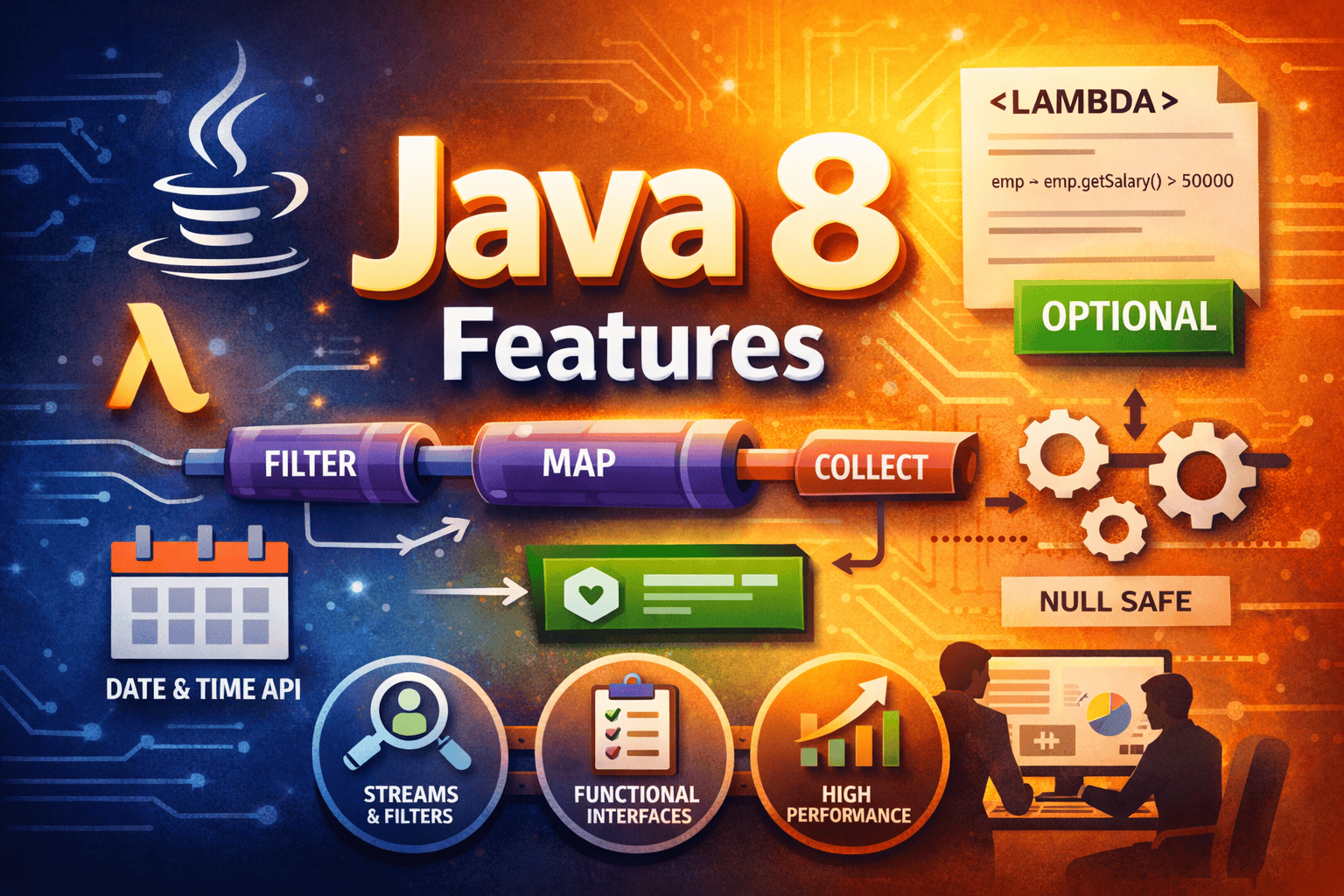
3. Streams API — Your Collections, but With Smart Powers
Streams are like a conveyor belt where data flows, gets cleaned, sorted, filtered, and packaged.
Mini Scenario:
You have 10,000 employees. You want to:
- Filter employees with >3 years experience
- Sort them by salary (highest first)
- Pick top 5
With Streams:
List<Employee> result = employees.stream()
    .filter(e -> e.getExperience() > 3)
    .sorted((a, b) -> Double.compare(b.getSalary(), a.getSalary()))
    .limit(5)
    .toList();
Bonus:
employees.parallelStream();
Java automatically uses multiple cores.
4. Default Methods — Interfaces that Age Gracefully
Before Java 8, adding a method to an interface broke implementations.
“Why not let interfaces evolve?”
interface PaymentGateway {
   default void logTransaction() {
       System.out.println("Transaction logged!");
   }
}
- Large enterprise APIs
- Shared SDKs
- Legacy systems
5. Optional — The Vaccine Against NullPointerException
java.lang.NullPointerException
Java 8’s Optional helps handle null safely.
String email = Optional.ofNullable(user.getEmail())
        .orElse("Email not provided");
userOptional.ifPresent(u -> sendEmail(u.getEmail()));
Cleaner null handling, better APIs.
6. Method References — Lambdas on Diet
employees.forEach(System.out::println);
Instead of:
employees.forEach(e -> System.out.println(e));
- Logging
- Mapping
- Conversions
7. New Date/Time API — Finally, Date Handling Makes Sense
Datewas mutable- Month index started at 0
- Formatting was painful
Java 8 introduced modern APIs:
LocalDateLocalTimeLocalDateTimePeriodZoneId
Example:
LocalDate dob = LocalDate.of(1998, 3, 15);
LocalDate today = LocalDate.now();

int age = Period.between(dob, today).getYears();
System.out.println("Age: " + age);
8. Collectors — When You Need End Results
Map<String, List<Employee>> byDept =
    employees.stream()
        .collect(Collectors.groupingBy(Employee::getDepartment));
Double avg = employees.stream()
    .collect(Collectors.averagingDouble(Employee::getSalary));
Real-Life Case Study — “Employee Dashboard in 8 Lines”
Map<String, List<Employee>> dashboard = employees.stream()
    .filter(e -> e.getExperience() > 5)
    .collect(Collectors.groupingBy(Employee::getDepartment,
        Collectors.collectingAndThen(
            Collectors.toList(),
            list -> list.stream()
                .sorted((a,b) -> Double.compare(b.getSalary(), a.getSalary()))
                .limit(2)
                .toList()
        )
    ));
“Here, hold my stream.”
❤️ Why Java 8 Still Matters
Even after newer versions, Java 8 remains widely used:
Used by enterprise systems
Default for Spring Boot
Streams & Lambdas everywhere
Core APIs still relevant
Java 8 is non-negotiable for serious developers.
Wrapping Up
Java 8 changed how Java is written:
- Less boilerplate
- Functional programming
- Better date handling
- Safer null handling
- Powerful Streams API
Whether it's banking, e-commerce, or microservices — Java 8 is still at the core.