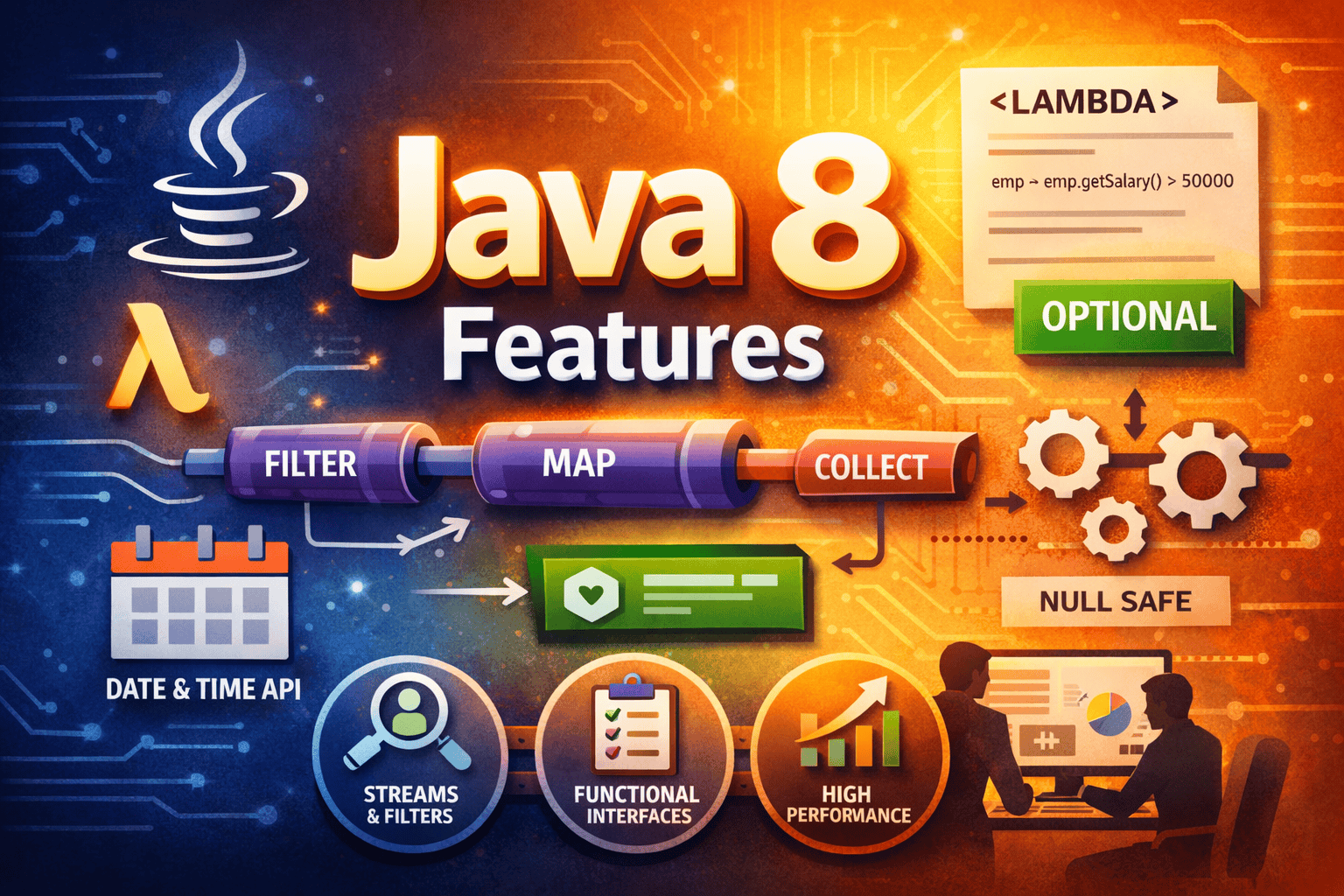
If you’ve been coding Java before version 8, you probably remember those days…
- Endless boilerplate code
- Anonymous inner classes longer than wedding invitations
- And
NullPointerExceptiongreeting us like an overly-friendly neighbour.
Then came Java 8 — and everything changed.
Think of it as the moment when Java put on sunglasses, entered the world of functional programming, and said:
“Let’s write less and do more.”
This blog takes you through the coolest Java 8 features with real-world mini-scenarios, code samples, and reasons why they still matter today.
Grab a coffee… let’s start! ☕
1. Lambda Expressions — Java Learnt to Whisper
Before Java 8, telling a Thread what to do felt like writing a mini novel.
Old Java (Too much talking)
new Thread(new Runnable() {
    @Override
    public void run() {
        System.out.println("Processing files...");
    }
}).start();
Java 8 (Short, sweet, classy)
new Thread(() -> System.out.println("Processing files...")).start();
Real Use Case:
Imagine you’re building a batch job that runs several background tasks:
- Sending emails
- Clearing logs
- Triggering cron jobs
Lambda expressions let you define those actions in one line.
Why it matters:
More productivity
Cleaner APIs
Less “noise” in your codebase
2. Functional Interfaces — Single-Method Interfaces with Superpowers
A Functional Interface has one abstract method.
Example: Predicate, Function, Supplier.
Think of them as “contracts” for behaviors.
Scenario:
You run an HR portal and want to filter employees based on different rules — experience, salary, department, etc.
Instead of writing multiple classes for each rule, you simply pass logic using lambdas.
List<Employee> highEarners = employees.stream()
    .filter(emp -> emp.getSalary() > 80000)
    .toList();
You just converted logic into reusable behaviors.
Boom.
3. Streams API — Your Collections, but With Smart Powers
Streams are like a conveyor belt where data flows, gets cleaned, sorted, filtered, and packaged — without you manually loop-ing a single element.
Mini Scenario:
You have 10,000 employees.
You want to:
- Filter employees with >3 years experience
- Sort them by salary (highest first)
- Pick top 5
In pre-Java 8 style, you’d write 25 lines of logic.
With Streams:
List<Employee> result = employees.stream()
    .filter(e -> e.getExperience() > 3)
    .sorted((a, b) -> Double.compare(b.getSalary(), a.getSalary()))
    .limit(5)
    .toList();
Bonus: Turn it into a multi-core beast:
employees.parallelStream()
Java does automatic parallel CPU execution.
You just wrote high-performance code without using a single thread or executor.
That’s insanely powerful.
4. Default Methods — Interfaces that Age Gracefully
Before Java 8, if your API needed a new method in an interface, congratulations… you just broke 25 classes implementing it.
Java 8 said:
“Why not let interfaces evolve?”
Now, interfaces can have implemented methods.
interface PaymentGateway {
   default void logTransaction() {
       System.out.println("Transaction logged!");
   }
}
Even if 50 services use this interface, they automatically get the new method.
Amazing for:
- Large enterprise APIs
- Shared SDKs
- Legacy systems
5. Optional — The Vaccine Against NullPointerException
We’ve all seen this:
java.lang.NullPointerException
…and we all died inside a little bit.
Java 8’s Optional is like asking Java:
“Give me the value… but safely.”
Scenario:
Fetching user email — but the field might be null
String email = Optional.ofNullable(user.getEmail())
        .orElse("Email not provided");
Or take an action only if value exists:
userOptional.ifPresent(u -> sendEmail(u.getEmail()));
Cleaner null handling
No more “if(obj != null)” everywhere
More expressive API design
6. Method References — Lambdas on Diet
Method references are Lambdas… but even shorter.
employees.forEach(System.out::println);
Instead of:
employees.forEach(e -> System.out.println(e));
Used heavily in:
- Logging
- Mapping objects
- Conversions
7. New Date/Time API — Finally, Date Handling Makes Sense
Prior to Java 8:
Datewas mutable (danger!)- Month index starts at 0
- Formatting was painful
Java 8 introduced:
LocalDateLocalTimeLocalDateTimePeriodZoneId
Real Mini Use Case
Calculate age from DOB:
LocalDate dob = LocalDate.of(1998, 3, 15);
LocalDate today = LocalDate.now();

int age = Period.between(dob, today).getYears();
System.out.println("Age: " + age);
Thread-safe, immutable, clean.
Perfect for:
- Billing cycles
- Policy expiries
- EMI schedules
- Ticket booking systems
8. Collectors — When You Need End Results, Not Raw Data
Streams help you process data.
Collectors help you assemble results.
Scenario:
Show department-wise employee list
Map<String, List<Employee>> byDept =
    employees.stream()
        .collect(Collectors.groupingBy(Employee::getDepartment));
Want average salary?
Double avg = employees.stream()
    .collect(Collectors.averagingDouble(Employee::getSalary));
These two lines, in old Java, would take:
- loops
- maps
- temporary collections
- 20 lines of code
Real-Life Case Study — “Employee Dashboard in 8 Lines”
Your app needs:
Senior employees (> 5 years exp)
Grouped by department
Sorted by salary
Top 2 from each group
Map<String, List<Employee>> dashboard = employees.stream()
    .filter(e -> e.getExperience() > 5)
    .collect(Collectors.groupingBy(Employee::getDepartment,
        Collectors.collectingAndThen(
            Collectors.toList(),
            list -> list.stream()
                .sorted((a,b) -> Double.compare(b.getSalary(), a.getSalary()))
                .limit(2)
                .toList()
        )
    ));
This would have been minimum 70 lines in pre-Java 8 code.
Java 8 said:
“Here, hold my stream.”
❤️ Why Java 8 Still Steals the Spotlight in 2025
Even after Java 21, 22, 23…
Java 8 remains the benchmark everywhere:
Used by almost all enterprise systems
For modern frameworks like Spring Boot
Streams & Lambdas became default coding style
Introduced APIs still used daily
If you want to be a great Java developer, Java 8 is non-negotiable.
Wrapping Up
Java 8 wasn’t just another update —
It taught Java how to think cleaner, run faster, and code smarter.
It:
- Reduced boilerplate
- Introduced functional programming
- Improved dates
- Eliminated null chaos
- Gave us Streams, Optional, Method References and more
Whether you’re building microservices, banking software, e-commerce, or even gaming engines — Java 8 is part of that DNA.

Leave a Reply